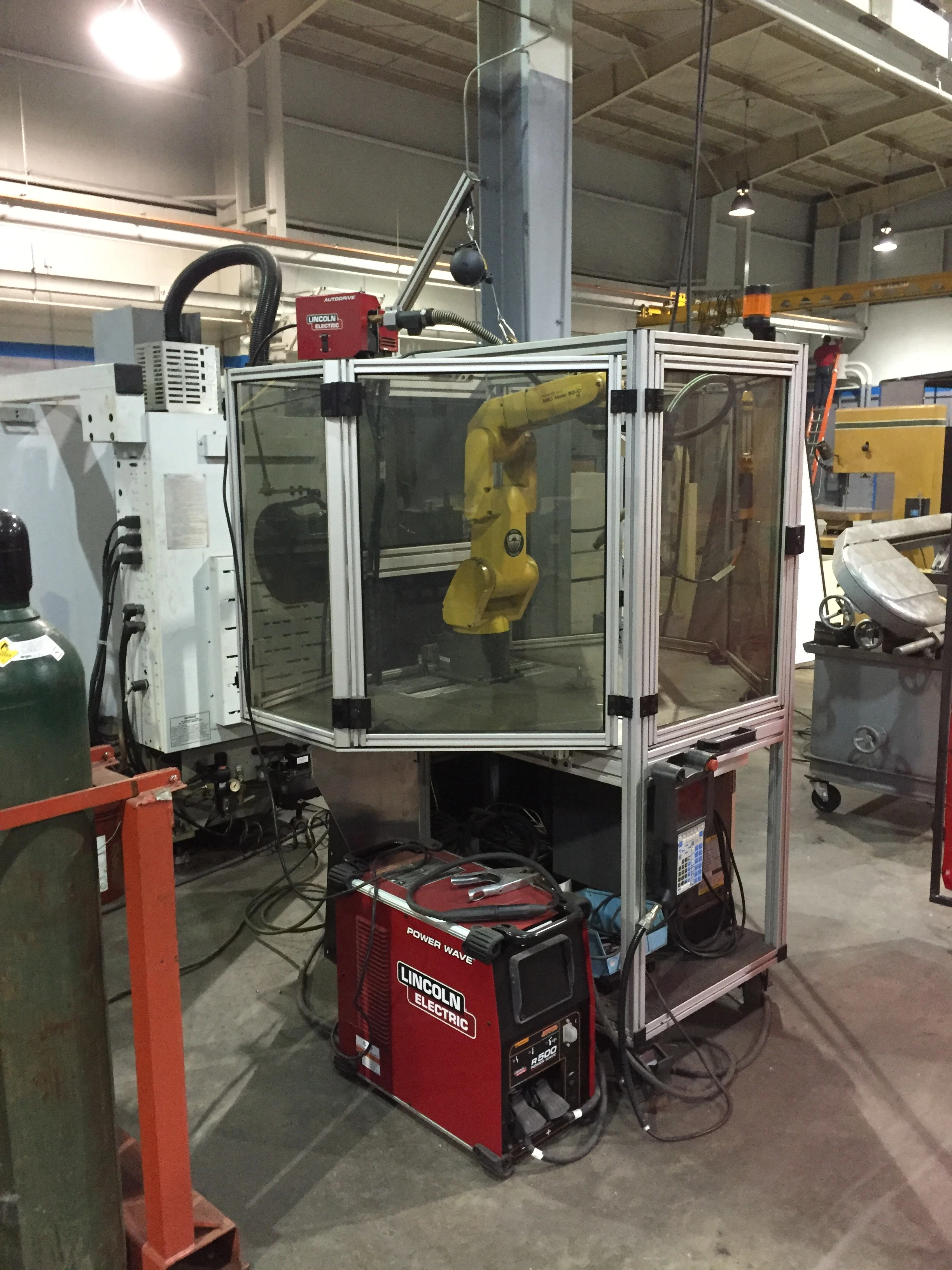
Robotic welding gets oversold. Every equipment vendor will tell you automation is the future, and they're not wrong in the long run. But right now, on a specific job with specific requirements, the question isn't "is robotic welding better?" — it's "is robotic welding better for this?"
We run a Fanuc Arc Mate 50iC 5L robotic cell with Miller Powerwave 500. Here's our honest take on when we use it and when we don't.
When Robotic Welding Delivers Real Value
Repeat Production Components
Robotics shine on repetition. If you have a component that runs in quantities of 50, 100, 500 — same geometry, same material, same weld joints every time — a robot programmed and qualified for that part will produce more consistent welds than manual welding over the length of a production run. Fatigue doesn't affect a robot at part 450 the way it affects a welder.
Complex Weld Paths That Are Geometrically Consistent
A robot can execute a weld path precisely and repeat it identically. If your part has a predictable geometry — consistent joint fitup, defined weld locations — robotic welding maintains those weld parameters shot-to-shot in a way that's difficult to match manually over volume.
Programs Where Variation Documentation Matters
For programs that require weld process data logging — current, voltage, travel speed, wire feed rate — robotic systems can capture and record that data automatically on every weld. For quality-intensive defense or aerospace programs, that traceability has value.
The break-even point for robotic welding is typically somewhere between 20 and 50 identical parts, depending on part complexity and setup time. Below that, manual welding is usually faster when you account for programming and fixturing.
When Manual Welding Is the Right Call
Low Volume and High Variability
One-off parts, prototypes, short runs of 5-10 pieces, or components where the geometry varies — manual welding by a skilled welder is faster and more flexible. Programming a robot for a one-off takes more time than just welding it.
Difficult Fitup and Variable Joints
Robots weld what they're programmed to weld. If your parts have joint fitup variation — which is common in fabricated weldments — a skilled manual welder adapts in real time. The robot doesn't. Chasing gaps and managing variable root openings is a human skill.
Access-Constrained Geometry
Some weld joints are in locations a robotic torch can't reach without re-fixturing or complex programming. A welder gets in there. Sometimes the geometry of the part simply favors human hands.
How We Make the Call at Jack & Sons
When a new job comes in, we look at volume, geometry, material, and fitup tolerance before we decide which process to run. We don't default to robotic welding because we have the equipment, and we don't avoid it out of habit. The right process is the one that produces a conforming part efficiently — and sometimes that's a robot, and sometimes that's one of our AWS-certified welders.
If you're not sure which approach fits your program, send us the drawings and quantities. We'll give you a straight answer.